Reflections Craft
Sign In
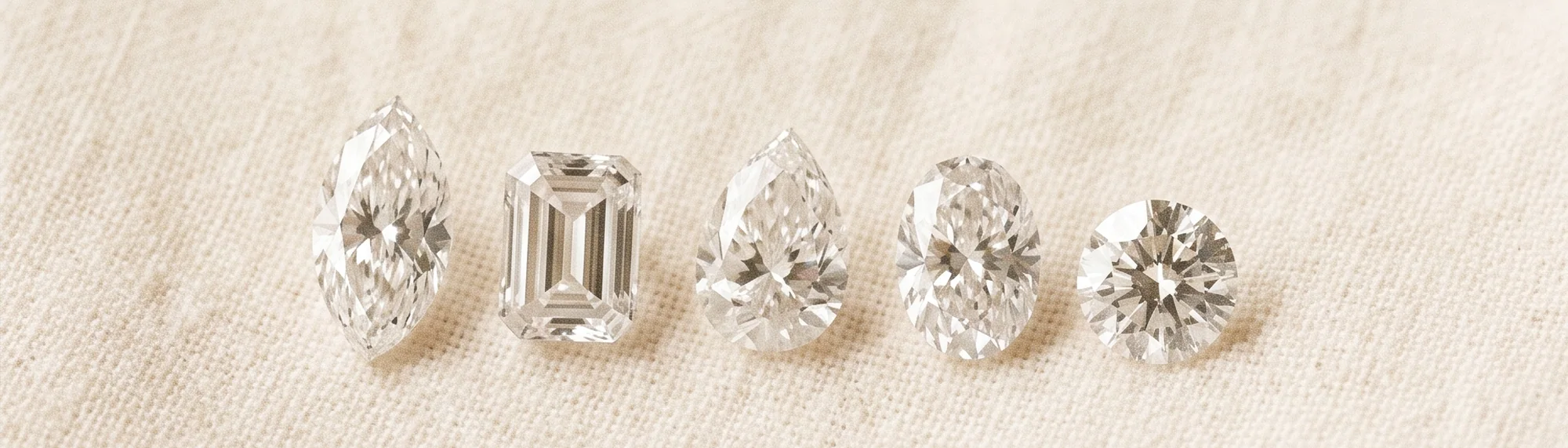
Loose diamonds in five shapes — marquise, emerald, pear, oval and round — on cream linen

Choose your diamond

Natural and lab-grown, every stone independently certified.

How to buy a loose diamond

Buying the stone separately from the setting is what gives you leverage. The same budget buys a visibly larger diamond if you are willing to move down a colour grade, or a visibly better-cut one if size matters less to you than sparkle. Every diamond listed here is certified, and every one of them fits any compatible setting in our collection.

Filter first by shape, because shape is the one decision that is purely about taste and cannot be corrected later. Then set a carat floor, then relax colour and clarity until the price lands where you want it. That order wastes the least money.

The 4Cs, ranked by what you will actually notice

  1. Cut. The only C that is about workmanship rather than luck. Cut grade controls how much light the stone returns to your eye, and it is the difference between a diamond that flashes across a room and one that looks grey. Buy the best cut you can and economise elsewhere.
  2. Colour. Graded D (colourless) through Z. Once a stone is set in yellow or rose gold the metal casts warmth into it anyway, so G–I is usually indistinguishable from D–F to the naked eye at a materially lower price. Reserve D–F for platinum and white gold.
  3. Clarity. A measure of internal inclusions. VS1–VS2 is eye-clean in almost every stone under 2ct, and SI1 often is too depending on where the inclusions sit. Paying for VVS or Flawless buys you something you cannot see without a loupe.
  4. Carat. Weight, not size. Prices step up sharply at the round numbers — 1.00ct, 1.50ct, 2.00ct — so a 0.95ct stone can cost noticeably less than a 1.00ct one and look identical on the finger.

Choosing a diamond shape

  • Round brilliant. The most light return of any shape and the safest resale. Also the most expensive per carat.
  • Oval. Elongates the finger and looks larger than a round of equal weight. Watch for the bow-tie shadow across the centre.
  • Cushion. Soft square outline with pronounced fire. Pairs naturally with halo settings.
  • Emerald. Step cuts trade sparkle for clean, architectural flashes. Inclusions show more, so buy a higher clarity.
  • Pear. A directional teardrop. Needs a V-prong at the point and a symmetrical outline — check the grading report.
  • Marquise. The best surface area per carat of any shape, and the strongest choice for an east-west setting.

Natural or lab-grown?

A lab-grown diamond is the same material as a mined one — crystallised carbon, 10 on the Mohs scale, graded on the same scale by the same laboratories. The difference is origin and price: at a matched specification a lab-grown stone typically costs 60–80% less. Natural stones hold resale value better because supply is finite. Neither answer is wrong; they optimise for different things, and you can filter for either above.

Once you have a stone in mind, head to complete your ring to pair it with a setting, or read the diamond buying guides.